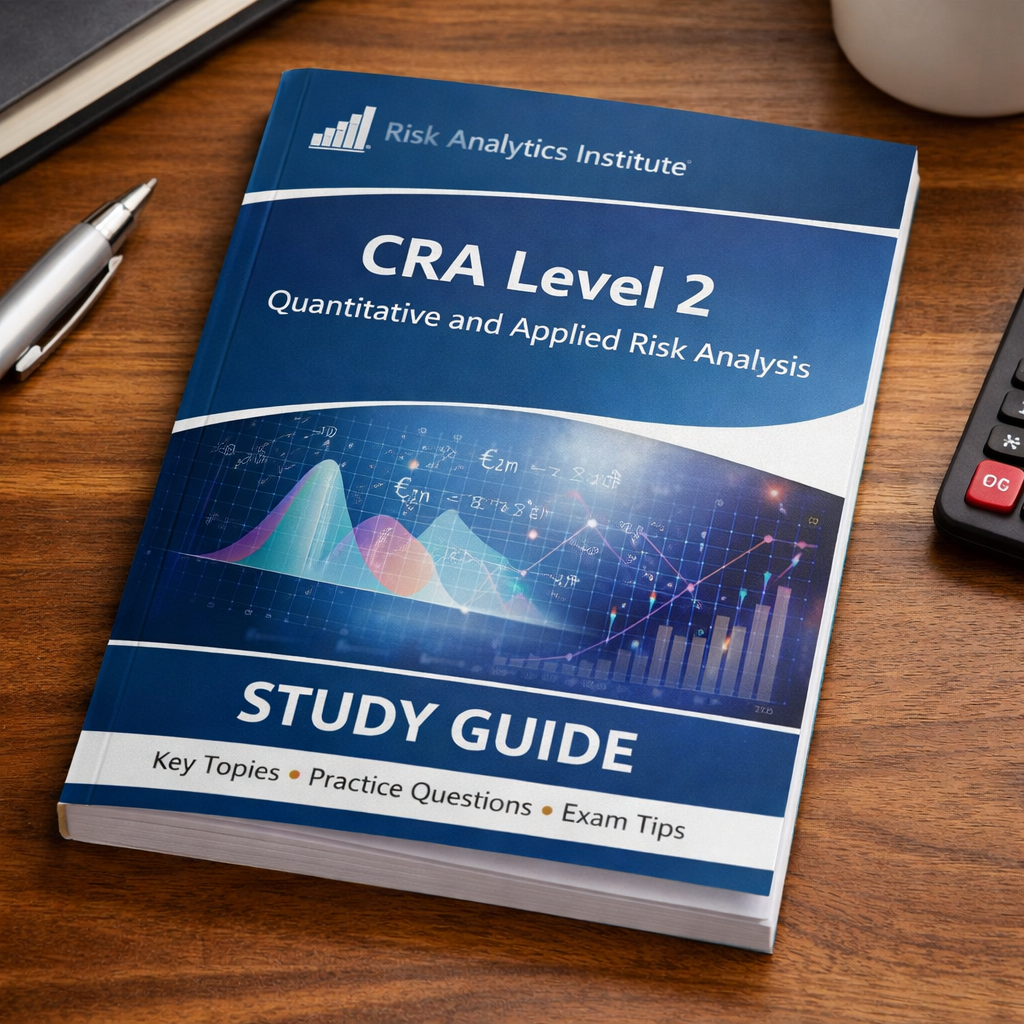
The CRA Level 2 Examination evaluates your ability to apply probability and statistical methods to risk analysis. It is aligned to the quantitative foundations covered in RAI102: Probability and Statistics for Risk Analysis.
The examination is structured across three super-sections covering statistical foundations, statistical inference and modeling, and the application of advanced analytical techniques in real-world risk contexts.
This examination must be completed independently by the registered candidate. You are expected to rely solely on your own knowledge, calculations, and judgment when responding to all questions. Copying, sharing, or reproducing exam content is strictly prohibited. The exam is monitored using proctoring software that records activity, including screen interactions, navigation behavior, and session activity. Any irregular behavior or suspected misconduct may result in review and potential disqualification.
Candidates are expected to demonstrate technical understanding and the ability to interpret and apply statistical methods in support of sound risk analysis and decision-making. The examination assesses probabilistic reasoning, statistical inference, model interpretation, forecasting, Bayesian updating, and practical application of analytical techniques to risk problems.
Probability, Data, and Statistical Foundations for Risk Analysis
Statistical Inference and Modeling
Advanced Analytics and Risk Application
This section assesses your understanding of the statistical foundations that support modern risk analysis. Questions cover probability theory, descriptive statistics, and probability distributions, focusing on how uncertainty is quantified, summarized, and interpreted in risk contexts.
Candidates are expected to demonstrate sound understanding of statistical reasoning, recognize when specific measures and distributions are appropriate, and interpret probabilistic outcomes in a risk analysis context.
This section evaluates your ability to draw conclusions from data and build statistical models. Questions cover sampling and estimation, hypothesis testing, and correlation and regression analysis, emphasizing how data is used to infer relationships and support decision-making under uncertainty.
Candidates are expected to interpret statistical outputs, evaluate relationships between variables, and apply inference techniques to support robust and defensible risk analysis conclusions.
This section assesses your ability to apply advanced analytical techniques in risk contexts. Questions cover time series analysis, Bayesian methods, and advanced risk analysis techniques, focusing on forecasting, probabilistic updating, and practical application of models in real-world risk scenarios.
Candidates are expected to demonstrate practical application of analytical methods, interpret model outputs, and apply forecasting and probabilistic reasoning techniques to support risk assessment, prioritization, and decision-making.